Monday, April 7, 2014

Homemade Playdough

Monkey loves playdough a lot. He loves to use playdough to make letters, snakes, shapes, and cut it up with a plastic knife. His love for this product started over a year ago. At that time, I didn't have any playdough. So I decided to use this recipe that I found on Musings From a Stay At Home Mom. And, I just have to say that this recipe is SO awesome. I still have the playdough in my fridge that I made over a year ago! This is what the playdough looks like right now: Looks pretty amazing for being a year old.


A year ago, I made 3 batches so I would have 3 different colors. I store the playdough in plastic tupperware containers (the very cheap ones). The playdough leaves a slight salty feel on your hand, but nothing like the regular salt play dough. It is soft and very easy to work with. When it is pulled out the fridge, it needs to be warmed up with your hands so it is easier to use. But, I don't mind since it was so cheap and easy to make. I totally recommend using this recipe.

Playdough Recipe
*note: this is the recipe from Musings From a Stay At Home Mom.
Ingredients:
  • 1 cup flour
  • 1 cup water
  • 2 teaspoon cream of tartar
  • 1/3 cup salt
  • 1 tablespoon vegetable oil
  • food coloring
Directions:
  • Mix together all the ingredients, except the food coloring, in a 2 quart saucepan. Cook over low/medium heat, stirring. Once it begins to thicken, add the food coloring. Continue stirring until the mixture is much thicker and begins to gather around the spoon.
  • Remove the dough onto wax paper or a plate to cool.

Here is a picture of Monkey playing and learning with the playdough during our letter "E" week:


Do you have a favorite homemade playdough recipe? Please share it!

Saturday, April 5, 2014

Off the Edge of the Map Book Review

Disclosure: I got this product as part of an advertorial.

When I saw this book, I just knew I had to read it! I love history, and I thought it would be interesting to read about explorers who "pushed the boundaries of the known world".

 
About the book:


From the #1 bestselling author of History’s Greatest Generals comes an exciting new paperback book on the greatest explorers in history and how their discoveries shaped the modern world
Whether it is Rabban Bar Sauma, the 13th-century Chinese monk commissioned by the Mongols to travel West form a military alliance against the Islam; Marco Polo, who opened a window to the East for Europe; or Captain James Cook, whose maritime voyages of discovery created the global economy of the 21st century, each of these explorers had an indelible impact on the modern world.

This book will look at the 11 greatest explorers in history. Some travelled for religious piety, such as Ibn Battuta, who travelled from North Africa to Indonesia in the 1300s, visiting every Islamic pilgrimage site between — and becoming counselor to over 30 heads of state. Others travelled for profit, such as Ferdinand Magellan, who wanted to consolidate Spain’s holdings on the spice trade. Still others travelled for discovery, such as Ernest Shackleton, who led two dozen men to the bottom of the world in an attempt to cross Antarctica on foot.

Whatever their reason for discovery, these explorers still inspire us today to push the limits of human achievement — and discover something about ourselves in the process.

About the author:

Michael Rank is a historian of the Middle East and a former journalist. He is the author of the Kindle #1 best-seller "From Muhammed to Burj Khalifa: A Crash-Course in 2,000 Years of Middle East History" and "History's Worst Dictators: A Short Guide to the Most Brutal Rulers, From Emperor Nero to Ivan the Terrible."

He blogs about history, religion, society, and culture at the website http://michaelrank.net. You can connect with him there, and he would love it if you did.

My thoughts:

I thoroughly enjoyed this book. I didn't get bored once nor did I have to force myself to keep reading. It was fun learning more about the explorers featured in this book. The explorers were picked based on their journeys instead of the significance of their discoveries. The explorers are: 1) Rabban Bar Sauma, 2) Marco Polo, 3) Ibn Battuta, 4) Admiral Ming Zheng He, 5) Hernan Cortes, 6), Ferdinand Magellan, 7) Captain James Cook, 8) Sir Richard Francis Burton, 9) Sir Henry M.Stanley, 10) Ernest Shackelton, and 11) Neil Armstrong.

I loved this quote:
It is the danger of death, thrill of achievement, and celebration of expanding humanity's horizon that will always trigger our desire to seek out the unknown. Most of all, we learn something of ourselves in the process.
The only thing I wished the book had was maps. I think it would have been helpful to have a map that came with each chapter so you knew exactly where the explorer went. I'm pretty good with my geography, but I had to look up a few things because there were a few places I wasn't too sure were located.

But, I would recommend this book to anyone since it was fun history book, and I learned a lot of new information.


I received one or more of the products mentioned above for free using Tomoson.com. Regardless, I only recommend products or services I use personally and believe will be good for my readers.

Friday, April 4, 2014

Not Even For A Second

Today was like any other day. BooBoo Bear, Goofy Girl, and I went to the park with some good friends. It was a beautiful day (minus the cloud cover that made it chilly) and it was a gorgeous park. Surrounded by football fields, soccer field, walking spaces, and playground equipment it seemed ideal. Two Tractors (and I mean tractors, not ride on lawn mowers) mowed the grass next to us.BooBoo was fascinated by the tractors and had a blast kicking around the ball our good friend (he calls her Momber, so I'll do the same) had brought. He even got brave enough to chase Momber's oldest son (J1) down to the soccer field and play with him and a couple of other older boys (sons of another good friend, we'll call her Carol).

Early in the playdate, as I was pushing BooBoo on the swings, my purse on the bench, I had a sudden thought, "I'm being really trusting leaving that there, maybe I should go stand by it." I was a bit surprised by that thought. There was no one there besides parents and kids, surely it was fine. The thought came again "I should stand by my purse." So, I did. I continued talking to my friends, but changed standing positions so that I was near the bench, but could still watch BooBoo (Goofy Girl was in her carrier).

Everything seemed normal: the kids played, we ate lunch, and people came and went. After an hour or so, Carol started gathering her things together. As she looked towards her car, she suddenly stopped. "I don't remember leaving my front window open..." she said and immediately started sprinting towards the parking lot. Sure enough, someone had busted her window in and stolen her purse. We then discovered that it had happened to a second car. Somehow, in all the bustle of park day and the tractors mowing, we'd completely missed two majors crimes.

That's when the wheels started turning.  I am so grateful for whatever caused that inspired thought to stand by my purse. It's not like I had much in there- we're not exactly swimming in cash, I can't drive so I only have a State ID (that's a whole other post), and I doubt most thieves really want diapers; but it was pieces of me. After Carol calmed down and got off the phone with all of her credit card companies and banks, she expressed the same thing:cards can be replaced, licenses can be renewed but, essential oils, favorite chapstick, and beloved nursing covers are a part of who we are. When they're taken, it violates our feeling of private security. At this point my thoughts really started going...

My son, 2 1/2, was playing almost a soccer field's length away from us, across rocks and down a hill. What if it hadn't been a thief? What if that had been a kidnapper? I always feel so safe surrounded by kids and women that I know that I realized I'd let my guard down about the most important thing in this world- our future. Now, I'm not advocating strapping him to my side with velcro and never letting him go again. On the contrary, he relishes his freedom and I believe he needs to learn to spread his wings. But I REALLY need to work on stranger danger. He's such a trusting kid, running off with kids he just met and walking over to their parents with no fear, that it's my responsibility to teach him to be cautious. I need to make sure that he knows to turn around and get my go ahead before going somewhere with someone he doesn't know. That he knows that it's OK to kick and scream if he's scared.

I guess my point is this: Don't, not even for a second, let your guard down. Even an idyllic day can be hiding something scary that could potentially turn dangerous. One obviously shouldn't live their life expecting a Boggart to jump out at any moment and therefore miss a bunch of good things in life; but you should have caution in all things. Oh, and ALWAYS listen to those random thoughts. Always, no matter how small.

Thursday, April 3, 2014

Pizza!

Like most families, we love pizza. Eating out can be pricey so I try to make a lot of the food we love at home. This pizza recipe is one I use on a weekly basis as my go to recipe when I need something quick and tasty to make for dinner.


Note: those who like to see pictures of the step by step process can find them at the end of the post

Pizza recipe
Ingredients:
  • pizza dough for 1 pizza pan (note: pizza dough recipe found below)
  • pizza sauce for 1 pizza (note: pizza sauce recipe found below)
  • 3 cups Mozzarella cheese, shredded
  • 1/2 package of turkey pepperoni
  • 3-5 white button mushrooms
  • 1/4 onion,diced or in wedges
  • 2 stalks green onion
  • 2 sprigs cilantro, chopped 
  • *and whatever toppings you want ( spinach, tomato, pepper, olives, etc)
Steps:
  1. Preheat oven to 450 F
  2. Start the pizza dough. While the yeast activates, prepare the pizza sauce. 
  3. Once the dough is done, grease a pizza pan and roll the dough out to fit the pan.
  4. While the dough rests, prepare the pizza toppings.
  5. Spread the sauce onto the dough
  6. Spread the shredded cheese over the sauce
  7. Finish the pizza with whatever toppings you want 
  8. Put pizza in the oven for about 12-15 minutes or until crust is a golden brown
  9. Enjoy!
Pizza sauce recipe
Ingredients
  • 1 can tomato sauce
  • 1 1/2 teaspoon Italian seasoning
  • 1/4 teaspoon onion powder
  • 1/2 teaspoon salt
Steps:
  1. Combine all the ingredients together and mix.
Pizza dough recipe
*note: this is a basic pizza dough recipe
*makes 1 regular pizza crust or 2 super thin-crust pizzas
Ingredients:
  • 3 teaspoons yeast
  • 1 cup warm water
  • 2 teaspoons sugar
  • 1/2 teaspoon salt
  • 2 tablespoons oil 
  • 2 1/2 to 3 cups all-purpose flour
Steps:
  1. Place the 3 teaspoons yeast and 2 teaspoons sugar into 1 cup warm water. 
  2. Combine the flour and the salt in a mixing bowl while the yeast activates and froths
  3. Once the yeast has "frothed", add the oil into the mixture.
  4. Pour the wet mixture into the dry mixture and mix (can be done with a kitchen aid or by hand)
  5. Knead the dough on a floured surface until it is elastic
Recipe with pictures:

1. Preheat oven to 450 F
2.Start the pizza dough. While the yeast activates, prepare the pizza sauce.


3. Once the dough is done, grease a pizza pan and roll the dough out to fit the pan.
4. While the dough rests, prepare the pizza toppings.
5. Spread the sauce onto the dough


 6. Spread the shredded cheese over the sauce


7. Finish the pizza with whatever toppings you want


8. Put pizza in the oven for about 12-15 minutes or until crust is a golden brown
9. Enjoy!


Wednesday, April 2, 2014

Yanker Anchors Easter Egg-stravaganza

I love having the opportunity to introduce people to my favorite WAHMs. Meet Amanda of Yanker Anchors. I stumbled across her page a couple of years ago through a giveaway and instantly fell in love. At the time she was mostly focusing on making her pages namesakes- an ingenious device meant to anchor blankets or a favorite toy to a stroller and make it impossible for the children to toss it in the street. She’d just started branching out into sock monkeys, and she had no idea just how much that side project would take off.

Now, not only does she make monkeys, she also makes caterpillars, foxes, turtles, cows, Pooh Bear, Minions, Dinosaurs, sloths, etc, etc. The list goes on and on. She can literary make almost anything. Her products are well made, much bigger than they look, and nice and squishy. We own a dinosaur from her and love it! She was in contact with me every step of the way and got it out fairly quickly. She is located in Canada, so the ship time is longer than some, but it’s worth the wait. Goofy Girl loves her dino:


When I first contacted Amanda about doing a review for her, I presented her with a query: Would she be interested in participating in an unique type of Easter giveaway? The answer was a resounding yes. So, here’s how it’s going to work. I’ve hidden Easter eggs (random phrases) on 4 of her pictures/posts. All you have to do is click on each of the Giveaway Tools and find where they’re hidden. Don’t worry, each egg should take less than 2 minutes to find. Then, all you have to do is like the picture, say something nice about it if you’d like, and then come back and enter the hidden phrase. If you find all 4 there will be 2 elective entries to like Howling Horn’s and Yanker Anchor’s Facebook pages. The prize? One of her adorable Peeps styled bunnies and it will arrive in time for Easter! How awesome would that be? A free squishy for Easter baskets! Amanda has also been generous enough to offer a discount for the winner. Any additional bunnies the winner purchases will be sold at a discount so that all of your kids/grandkids/nieces/nephews/etc can have one if you want. Isn’t that amazing?

Have fun finding those eggs and make sure you pop over and thank Yanker Anchors!

Book Review: Plotting the Course- Life Lessons From the Sport of Sailing


*Disclosure: I received the book mentioned in this post at no cost in order to do this review. All opinions are my own.

www.rickarneson.com


was recently sent a copy of Plotting the Course- Life Lessons From the Sport of Sailing by Rick Arneson for review. Here’s the description from the author’s website:
Sailing is more than simply a sport for many people the world over; it’s also a way of life. There are valuable lessons inherent in the sport of sailboat racing that have enriched the lives of sailors for generations. In Plotting the Course, readers are given a glimpse into the vast and diverse world of competitive sailing and shown valuable tools that the sport can provide for finding success in the ways we live and work. 
The foundation of Plotting the Course is the cyclical nature of life’s experiences in parallel with those of a sailing campaign. The challenges that a sailor faces in mounting a competitive effort tend to mirror those that anyone would find in a worthy endeavor onshore, from the early planning stages to the moment of performance and on to the learning phase that follows each challenge and precedes the next. Each of these phases is explored using examples from the world of sailing and provides takeaways that apply for use in life on shore; in business, relationships, or everyday situations.
The competitive worlds of sailing and business have much in common, and the lessons of each translate well to the other. In Plotting the Course, readers will see comparisons between the experiences of top sailors and those of businesses like Walmart, McDonald’s, Nintendo, Apple, and Lockheed Martin to name a few, as well as business leaders like Jack Welch, Richard Branson, and John D. Rockefeller. Lessons on topics such as leadership and decision making stretch beyond the world of business and into the political realm, with looks at the lives and careers of American presidents and other political leaders.
The lessons included within Plotting the Course are not only universal, but timeless as well. Readers will find parallels between the strategic decisions of Hannibal of Carthage and Queen Elizabeth I and those of a sailor navigating rough waters or facing a more powerful opponent. Other examples include illustrations of what WWI aircraft design and London’s cholera epidemic in the 19th century have in common with a sailor’s search for more speed. As these pages show, there is much to be learned from the lessons of history for sailor and non-sailor alike. 
Plotting the Course is about much more than sailing; it’s about seeing challenging situations in a new light to get to the heart of a problem and illuminate a solution. It’s about holding on to the lessons we learn over time and using them to drive us forward. It’s about dreaming big, dealing with uncertainty, struggling through loss and adversity, building on success, facing opposition, living and working well with others, and through it all, pursuing happiness.
I was also privileged to receive a Q&A post from the author:
When did you first sail? My first time ever on a boat, I was just a week old. My family brought me out on our boat for the 4th of July. The first time I ever sailed on my own, though, was when I was about six years old and starting sailing lessons in the summer. I learned in Sabots, little 8-foot pram dinghies that are very popular in Southern California with both kids and adults.  
What was it that hooked you as a sailor? It’s hard to point to one aspect of the sport that really won me over. I think that once I started to learn more about what goes into winning sailboat races, I really began to appreciate the nature of the sport. The fact that it’s a combination of the sailor’s mental game, physical fitness, and boatspeed that adds up to the outcome of the race made it more intriguing for me because it levels the playing field. You don’t have to be of a certain height or build to be a good sailor, and you don’t have to be a genius or have the newest boat to win races. It’s a balanced combination of those factors that makes the difference, so lots of different people can compete. I just found it to be a more interesting sport that way. Bottom-line, though, I stuck with it for all these years because I haven’t stopped having fun with it.  
When did you know you wanted to be a writer? It’s actually been a gradual transition for me. I used to write for fun as a little kid, just playing on my grandmother’s typewriter and making up my own stories. I didn’t realize that I had any talent for it until around middle school and high school, through the encouragement of my teachers. I put together regatta reports all through high school and college for my club’s and college sailing team’s newsletters, and then began submitting feature articles to sailing publications once I started coaching sailing full time. While in business school, many group projects required the submission of a comprehensive paper, and I was often asked by my teammates to be the one to compile and edit our findings to make the paper come together coherently. After grad school, I wrote a lot of marketing plans and ad copy in my work, but I also joined the editorial board of the US Snipe Sailor magazine, and that kept writing fun for me. I actually didn’t set out to be a writer at first. I just did a lot of writing over the years and it eventually led to me putting together a book. 
 What is the most important human factor in sailing? There are a number of important ones that come to mind, but I’d say patience is a universal requirement for sailors. For racing sailors, opportunities come along once in a while in the form of windshifts that make certain tactical moves tempting because they might offer an immediate gain. The challenge is recognizing which opportunities to pursue, because chasing one windshift often means giving up another. If you impulsively react to every shift without considering the bigger picture, you can end up losing distance instead of gaining. We can’t make the wind do what we want—what we can do is anticipate and plan for what is the next most likely outcome. If it doesn’t work out the way we expected, we need to be patient enough to keep focused and rework our strategy accordingly. Whether racing or not though, patience is a virtue that any sailor needs to cultivate.  
Why do you feel the components of sailing are such a great metaphor for being successful in business? Both arenas require a lot of the same things from people who want to succeed at either. They both require a lot of advance planning and organization, the ability to work with others, the ability to handle competition and make good decisions quickly, and the ability to gather and use information for constant improvement, just to name a few.  
What is more challenging, sailing or writing? I’d say sailing is more challenging for me, probably because of the competitive aspect. With sailing, I am not only trying to do my best, but I’m under constant pressure from all the other boats trying to get in front of me. I had to put in a lot of work in the beginning to become competitive in sailing, and as the competition constantly improves, I continually have to keep up. With writing on the other hand, I had more of a natural knack for it, even from childhood. I’ve always liked writing because even though there is structure involved, there’s a lot of creative freedom. I love them both, but they’re very different by themselves. It’s great for me to be able to combine the two.  
What is your greatest experience as a sailor? There are so many great ones, but I’d say the most personally significant is the first time I ever won a first place trophy as a youth. It was just a little club series, and I think there were probably only about five or six boats competing, but it meant the world to me at the time because it was my first tangible reward for all the time and effort I’d been putting in to getting to be a better sailor. I still have that trophy, of course, and it’s a nice souvenir of a special turning point in my sailing career.  
Who do you see as the core audience for Plotting the Course? Through the writing process, I had to consider whether to write it just for sailors or for a wider audience, and I felt that the material had so much to offer whether the reader was a sailor or not. So, I tried to put it together so that a newcomer to the sport could follow along without getting too swamped with sailing jargon, while experienced sailors could enjoy it without having the sailing examples get watered down. I think sailors will have a special, built-in connection to the material already, but the book speaks to all those who are reaching for the next rung on the ladder—those who are always seeking new tools to help them grow and improve in their lives and careers.  
What do you hope readers will take from your book? The central premise of the book is that the things we are passionate about can offer more than just the enjoyment they provide in and of themselves. Our passions can also serve as frameworks for the way we live and work. In my case, because of my relationship with the sport of sailing, I was able to draw out many of the lessons for success that I’d learned on the water and apply them to other areas of life, business among others, in order to bring that comfort zone with me into other areas. When I was first studying business, making analogies between business principles and sailing helped me in my classes, and I found that bringing those principles back into my sailing also helped me on the water. Because I had that passion for sailing, I was able to make the world of business more familiar and accessible as I learned about it by making connections between the two. Whether it’s through sailing or another subject you can relate to deeply, look to your passion to find inspiration in other areas, and you may find some familiar principles applying to your situation in a fresh and enlightening way.  
What is next for you as a sailor and a writer? I’ve got a busy year of racing ahead. My sailing focus is on campaigning towards a couple of international Snipe regattas, including the Western Hemisphere & Orient Championship and the trials for the Pan American Games. I’ll also be doing some match racing events, and sailing Lasers when I can. I’m pretty certain that I’ll be starting work on another book before the year is out, but I’m considering a couple of different ideas, so I want to sort out which idea to pursue first and come back to the others down the line.  
Where can people go if they want to learn more about you and your book? I’ve got a website up, www.rickarneson.com, which also includes some resources for people who would like to learn a little more about the sport of sailing.  
My Thoughts:

As previously stated, I am not a swimmer. At all. As such, I am also not a sailor. The very little I know of the sport has been gleaned from such books as Cheaper By The Dozen. Therefore, I was either the ideal person to read this book (since it claims to be aimed at beginners as well as experts) or the worst person possible. To be honest, I found the book a little hard to follow. I did enjoy the brief glimpses into the historical facets of the sport, but I felt they were a little few and far between. The technical jargon was a little too prevalent for my taste. However, once I was able to get past that, I found the author has a very entertaining voice and lots of good life lessons to share.


I think that this is an excellent book for people who already have some history with sailing or who just want a few new ideas on how to better succeed in life. However, I wouldn’t necessarily recommend it if you’re as novice as I am when it comes to sailing. The metaphors come too often using too many technical terms to really be of help for those of us in this category. I thoroughly enjoyed the opportunity to review this, and am intrigued to see what else the author has offer further down the road.

Tuesday, April 1, 2014

A Week of Letter "K"

Spring weather is so hard to predict where I live. One minute it is sunny and the other minute is it snowy. So, some of my activities had to be changed due to the snow on the ground such as flying a kite. Oh well, it's life. Anyways, I hope you enjoy this week of activities and I hope you get some inspiration on how to teach your kiddos (Oh, and be sure to check out Howling Horn's Pinterest page for more great learning activities). And, I would love to hear any ideas you have!


Monday - Reading

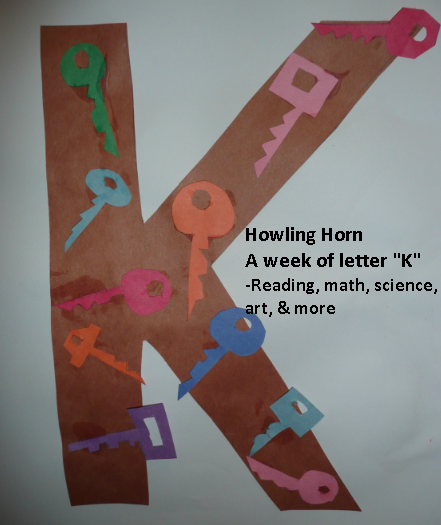
Monkey is obsessed with keys so I just knew that the letter of the week project would have to feature keys. This idea came from, No Time For Flash Cards, and it worked out so well. Monkey loved picking out what keys to glue to the letter "k".


Then we worked on writing/tracing the letter "k". This sort of worked. Monkey would attempt to write the letter "k" out, but eventually decided coloring was a better idea. I figure as long as I keep showing him how to write letters, then someday he will want to do it too.


Tuesday - Science

Two words: car ramps. My ideas came from this great website. I made a very basic car ramp in order to explore kinetic energy with Monkey. Now, I will admit that I think Monkey only cared about watching the cars (and other vehicles) roll down the ramp, but I know he is learning to experiment because he had fun testing out different vehicles and even wanted to try out his big dump truck.


We first investigated one car and then we did two cars at the same time to see how their weight affected their speed.I explained to Monkey that kinetic energy is the energy of motion as I rolled a car down the ramp.


We even explore how kinetic energy is transferred. This was his favorite part. He loved seeing how many objects his train could knock over. I have to say that I had a lot of fun doing this experiment too!

Wednesday - Math

I would recommend this activity for older kids since it didn't go over as well as I planned. Monkey just didn't care to do it. I was a bit sad since I spent how much time getting all the materials to make kites and count the "k" shaped ribbons.


But, basically, your kiddos would count the "k" ribbons and discuss the shapes that are used to make the kite. I am hoping that when I revisit this activity with Monkey, then he will enjoy doing it. 


Thursday - Art

I decided to be brave again and create my own activity. So today we made a king's crown. It actually turned out pretty well and Monkey loved how he got to paint!

These are the supplies you want: a paper plate, paint, paint brushes, jewels, and pom poms (or whatever you want to decorate the crown with). After the paper plate is painted, I then cut the middle of the paper plate like a pie. I decided to make "6 slices". I cut down to the ridges of the paper plate and stopped. Then, I had Monkey decorate the crown anyway he wanted too. 


I think this king's crown turned out really well. 


Friday - Physical Exercise

Today, I planned to fly a kite. Monkey was SO excited to do this. But, sadly the weather for several days has been snowy and cold. We then decided to kick a ball in our yard since there were a few areas that weren't extremely muddy.


As we played with some balls, I would keep saying "K is for Kick". Monkey was extremely focused on the kicking part!

Saturday - Music

We started off our music session by watching Story Bots. Monkey loves their little alphabet videos. We ended up watching it several times. Then, we had a blast playing with a keyboard. We already had this keyboard around this house, but I don't have it out all the time. Monkey loved just tapping away at the various keys and hitting buttons to make the music sound different. I took the time to talk to Monkey about what a keyboard is and what it does.


I then just allowed Monkey to learn about the keyboard by experimenting with it. Hands-on learning is awesome. This keyboard plays some church songs, and Monkey liked listening to it while he played with his trains.

Sunday - Religion

We ended this week by learning about kings. I talked with Monkey about two different kings: King Benjamin and King Noah from The Book of Mormon. I showed pictures of the two kings and explained how King Benjamin was a righteous king who loved his people and served them while King Noah was a wicked king. I explained the importance of having righteous kings. We finished the lesson by watching the animated series of Abindai and King Noah.

Need more alphabet ideas? Then check out these posts:

Letter A   Letter B   Letter C   Letter D   Letter E   Letter F    Letter G   Letter H   Letter I   Letter  J